
Why the “Why” is the New “How”
How Intentional Intelligence Redefines Global Success in the Age of AI

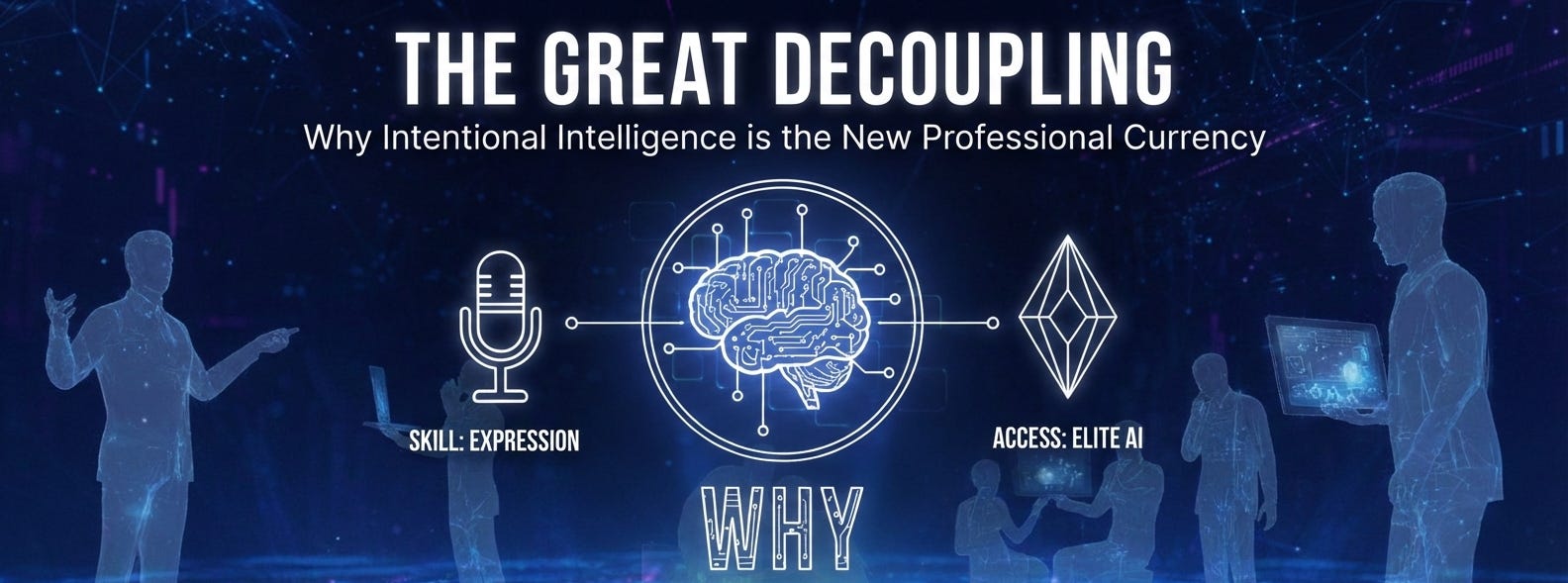
For centuries, the trajectory of a human life was largely determined at birth. If your parents possessed a significant bank account balance, your path was clear. You had access to the world, the best schools, prestigious internships, and a network that ensured you would score well in life. Your success was a product of physical, cultural and financial inheritance. But as we enter a world saturated with artificial intelligence, this ancient structure is collapsing.
The Calculator Trap and the Math of Meaning
Imagine two students in a math class: one has a calculator, the other doesn’t. The one with the tool wins every time. But put them in an English class, and the calculator is useless.
AI is the ultimate calculator for everything. However, to operate this “universal calculator,” you must know the mathematical operation you wish to perform. In the past, knowing “how” to calculate was enough. Today however, AI itself can tell you the “way” (the how) to a certain outcome, but only if you know how to “prompt”.
The new bottleneck is a combination of “Why” and the skills associated with “prompting”. If you don’t know why you are asking a question, your prompt will be hollow, and your result will be irrelevant. If you don’t know how to express yourself clearly in thinking, writing or speaking, your prompt will render your “Why” meaningless.
The New Hierarchy of Intelligence
I forsee a future divided (in terms of professional success) into several distinct classes based on their relationship with AI:
The Dependent Class: Those who cannot formulate a “why” nor express it. They may rely on Universal Basic Income (UBI) and do exactly what the state or the machine tells them because they have no other choice.
The “Feeling” Professionals: Those in roles that require warm-heartedness, human touch, or physical presence (such as caregivers, therapists, or massage practitioners). These roles remain a sanctuary for human-to-human connection.
The AI-Integrated Elite: Those who use AI as an accelerator. They maintain their “freedom of choice” because they can still function if they put the tool down.
The Fully Merged: A theoretical group where the line between human and machine vanishes (think “Neuralink” or a “chip in the brain”), however with their “all-in” approach, it may be hard for them to realize whether they’re master, or slave.
We will be witnessing a profound decoupling of success from traditional pedigree. In this new era, the technical how is becoming a commodity available to anyone with a screen. This shift is leaving behind a new set of gatekeepers: the Why (intentional intelligence), the How to Ask (the skill of expression), and the quality of the tools you can access (privilege).
The New Architecture of Privilege: Access and Intent
In the old world, privilege was a silver spoon. In the new world, privilege is a high speed interface and the cognitive depth to use it. If in the past your upbringing determined your ability to navigate university and job markets, today your status is defined by a different trinity:
Access: Your ability to utilize the highest level of intelligence tools available. Just as a student with a calculator will always outperform one with only a pencil in a math class, the individual with premium, unrestricted access to top tier AI will leapfrog those using outdated or limited models.
The Why: This is real intelligence. It is the ability to look beyond data and understand the purpose behind a task. It is the curiosity to ask why we are doing this and where it leads.
The Skill: This is the ability to communicate better. It is the mastery of language and thought that allows a person to translate a complex internal vision into a precise external command.
The Governance of the Mind: A Model for the Future
To visualize how these new forces interact, we can look at the structure of a functioning nation. This analogy helps define the hierarchy of success in an automated age:
The People represent The Why: The people are the source of intent. They hold the values and the vision for the future. Without the people, there is no purpose. In the professional world, this is your raw intelligence and your ability to define the goal.
The Government represents The Skill: The government takes the raw will of the people and organizes it into laws, strategies, and structures. This is your ability to communicate and express yourself. It is the interface that turns a desire into an actionable plan.
The Executive Branch represents the AI: The executive branch is the machinery that enforces the laws and performs the labor. It is the engine of execution. It is powerful, but it is mindless without the guidance of the government and the intent of the people.
Success belongs to those who can act as both the People and the Government. If you cannot organize your thoughts (the government), the executive branch (the AI) will act erratically or fail to serve your interests. If you do not have a why (the people), you have nothing for the government to organize. Any finally: if you’re unable to execute your plan yourself without the “Executive Branch of AI”, you’re as dependent as the first group mentioned above!
The Communication Bottleneck: Why the Radio Station Matters
So on one side are the independent achievers who use AI as an accelerator. On the other are the dependent who lack the skill to express their intent and must rely on others or the state to survive.
One of the most vital skills for remaining in the achieving class is the ability to respond and express oneself in real time. This is why the best advice for a young person today is to present something live, be part of a campfire discussion, moderate or mediate a dispute, or simply seek an internship at a radio station rather than a coding bootcamp.
A live radio environment forces a person to:
Handle live callers with unpredictable needs.
Respond instantly with clarity and poise.
Play off a co moderator and read the room.
Express the why behind every segment to keep an audience engaged.
This is the ultimate training for the future. If you can express your thoughts and feelings clearly under pressure, you can direct any AI. If you cannot communicate, you are effectively locked out of the power that AI provides. You become like a person who was given a task but returns a result that has nothing to do with the assignment because they could not bridge the gap between human requirement and machine prompt.
The Human Sanctuary: Wisdom vs Data
There remains a final frontier where the machine cannot compete: the depth of human experience. While AI is exceptionally good at processing data, it lacks the underconscious application of wisdom that comes from living a life.
A machine can analyze your current performance, but a seasoned leader can look at your soul and see where you will be in twenty years. This type of guidance is not based on achievements or specific skills; it is based on a hierarchy of life experience. In the past, we built hierarchies based on age and achievements, and more recently on skill and achievements. Both are becoming obsolete. The new hierarchy is based on the ability to see and direct human potential, a quality that requires a heart and a history.
In the future of work, roles that require a human touch, such as caregivers, mentors, and therapists, will become more valuable precisely because they cannot be automated.
The Path to Independence
The difference between success and failure in this new world is the difference between independence and begging. To succeed, one must move beyond the mechanical execution of tasks. You must own your why, master your ability to express it, and ensure you have the best tools to execute it.
The people who will lead the future are those who understand that while the AI can calculate the way, only a human can decide where the journey should go. By focusing on intentional intelligence and the timeless skill of clear communication, we can ensure that we remain the masters of the tools we have created, rather than their subjects.
Nice post with some interesting perspectives. I especially like the way you frame the importance of in the moment clear communication as an important human skill and the example of a call in radio show.
I do have some doubts or counters to the points you raise:
1. I don’t think that people using the most premium AI tools will necessarily out perform the majority. I think those who know how to orchestrate the right tools for the right outcomes will get better results. And using the most premium, general purpose models isn’t guaranteed to get you the best outcomes each time. Just like a student who uses the most premium, advanced calculator could loose out to someone with a simple one depending on the job.
2. You are making an assumption that there won’t be some breakthrough in world or neural reasoning models that allows us to teach or provide a world view to systems. I don’t think that is likely anytime soon but it does seem conceivably possible eventually.
3. The different types of users are highly extreme. The slaves, the users, the symbionts. Yet the reality is more likely to be a wide spectrum. Just like roles and work will require a wide spectrum of task work.
4. Universal basic income in any form doesn’t seem especially likely in any near horizon of time.
Otherwise, it was a nice read and got me thinking about these topics in interesting ways. Thank you!